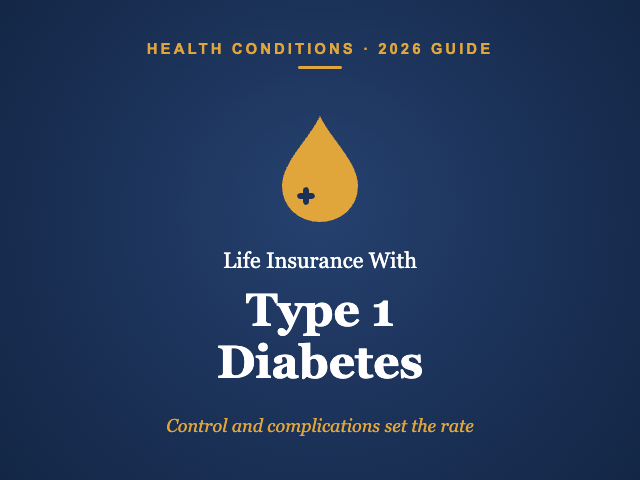
Life Insurance with Type 2 Diabetes: What You’ll Actually Pay (2026 Guide)
Yes, you can get life insurance with type 2 diabetes — often at standard rates.
If you have type 2 diabetes, somebody has probably told you that life insurance is going to be brutally expensive — or flat-out impossible. Maybe it was a coworker. Maybe it was a pushy agent who only sells one company’s products. Maybe it was a form on the internet that “declined” you in eight seconds.
If diabetes has affected your kidneys, see our related guide to life insurance with kidney disease (CKD).
Here’s what I tell my own clients, and I want you to hear it before anything else: well-managed type 2 diabetes is one of the most insurable “serious” conditions in all of life insurance. I’ve placed clients with A1Cs in the 7s at Standard rates. I’ve seen carriers hand out rates one notch below their best class to diabetics who keep their numbers tight. The trick isn’t luck — it’s knowing which of the 25+ carriers on my shelf actually likes diabetic applicants, and presenting your case the right way.
This guide walks you through exactly how underwriters think about type 2 diabetes, what you’ll realistically pay, and how to avoid the mistakes that turn an easy approval into a decline letter.
Type 2 diabetics with a controlled A1C
Often required; no-exam options exist
Term, whole life, final expense
Instant to ~6 weeks
Diabetes-friendly underwriters
Choose AM Best A-rated or higher
Can you really get life insurance with type 2 diabetes?
Yes — and for most people reading this, at far better rates than you fear. Roughly one in ten American adults has diabetes, and carriers would be walking away from an enormous market if they declined everyone with an elevated A1C. They haven’t. Instead, they’ve gotten very good at sorting diabetic applicants into tiers.
Think of it as three broad buckets:
| Your situation | Likely outcome | What that means |
|---|---|---|
| Diagnosed after 40, A1C under 7.5, no complications, oral meds or diet-controlled | Standard — sometimes better | The same rate a “healthy” person with a few minor issues pays |
| A1C 7.5–8.9, or insulin-controlled, or diagnosed in your 30s | Standard to Table 2–4 | Approved, with a 25–100% surcharge depending on the carrier |
| A1C 9+, or recent complications (neuropathy, retinopathy, kidney involvement) | Table rated or postponed | Higher cost now — often improvable within 6–12 months |
Yes — most people with well-managed type 2 diabetes can get real life insurance, often at Standard rates. Your A1C, how you control it, and the carrier you apply to matter more than the diagnosis itself. Because each company reads diabetes differently, comparing carriers is what gets you the best price.
The 5 things underwriters actually check
The best-case math: the two numbers that move your rate most are your A1c and how long you have had diabetes. The most favorable outcome — a strong non-smoker class — generally needs blood pressure around 135/85 or better, HDL cholesterol above 45, a healthy weight, and no diabetic complications, plus diet-only control if you were diagnosed between 30 and 49, or no insulin if you were diagnosed at 50 or older. Insulin use, complications, or high readings push toward a table rating. Well-controlled, long-standing diabetes still lands offers; the price just varies a lot by carrier.
When your application hits an underwriter’s desk, they’re not reading it like a doctor. They’re reading it like a bookie setting odds. Here’s their checklist, in rough order of importance:
1. Your A1C — the headline number
Under 7.0 is the gold zone. 7.0 to 7.9 still gets Standard offers from the right carriers. Things tighten in the 8s, and at 9+ most carriers want to see improvement before offering their good tiers. If your A1C has been drifting down — say 8.4 a year ago, 7.6 now — that trend line genuinely helps, and I make sure underwriters see it.
2. Age at diagnosis
Counterintuitive but true: being diagnosed at 52 is better for underwriting than being diagnosed at 28. The longer diabetes has had to compound, the more cautious carriers get. Diagnosed young? You’re still insurable — we just have to be pickier about the carrier.
3. How you control it
Diet and exercise control reads best, oral medications like metformin read nearly as well, and insulin reads more conservatively — though a handful of carriers treat well-managed insulin users surprisingly kindly. Needing insulin is not a decline. It just narrows the list of carriers I’d send you to.
4. Complications
This is the big fork in the road. Diabetes plus neuropathy, retinopathy, or kidney disease moves you into table ratings. Diabetes alone, cleanly managed? That’s an everyday approval.
5. Everything else on your chart
Blood pressure, cholesterol, weight, smoking. Diabetes plus a second risk factor multiplies — it doesn’t add. A diabetic smoker doesn’t pay two surcharges; they pay a category worse. The good news cuts the same way: a diabetic with great blood pressure and a clean weight gets real credit for it.
- Your last A1C was under 8.0 (bonus points under 7.0)
- You see your doctor at least once a year and take meds as prescribed
- No diabetic complications — eyes, nerves, kidneys all clear
- You were diagnosed after age 40
- Blood pressure and cholesterol are managed (treated is fine)
- A1C is 9.0 or higher on your most recent labs
- You’ve had diabetic complications or a blood-sugar-related ER visit
- You smoke on top of diabetes
- You were diagnosed as a teenager or young adult (we may look at different carriers entirely)
What you’ll pay: real 2026 rate ranges
These are realistic monthly ranges for a $500,000, 20-year term policy for a non-smoking man with type 2 diabetes and no complications. Women typically pay 15–25% less. Your exact number depends on your labs and the carrier we choose — treat these as honest ballparks, not promises.
| Age | Well-controlled (A1C < 7) | Controlled (A1C 7–7.9) | Less controlled (A1C 8+) |
|---|---|---|---|
| 40 | $48–$65/mo | $60–$85/mo | $90–$140/mo |
| 45 | $70–$95/mo | $85–$120/mo | $130–$190/mo |
| 50 | $105–$140/mo | $130–$180/mo | $195–$280/mo |
| 55 | $160–$215/mo | $195–$270/mo | $290–$420/mo |
| 60 | $250–$330/mo | $300–$410/mo | $450–$640/mo |
Two things jump out of that table. First, the spread within each row — that’s the difference between the right carrier and the wrong one, and it’s exactly why an independent broker earns their keep. Second, the cost of waiting: premiums climb roughly 8–10% for every year older you get. Your A1C might improve next year, but your age never does.
Not sure which carrier reads your diabetes best?
Compare diabetes-friendly carriers with an independent broker — no fees, no pressure.
Request a quoteWhy the carrier you pick changes everything
Every life insurance company publishes underwriting guidelines, and they disagree with each other constantly. One carrier caps every type 2 diabetic at Table 2 no matter how pristine the labs. Another offers Standard Plus to diabetics with A1C under 7 and a clean cardiac history. Same applicant, hundreds of dollars a year apart.
A few patterns from my desk: John Hancock runs a program built specifically for people living with diabetes, with rewards tied to managing it. Prudential is historically generous with later-onset, well-controlled cases. Banner Life often prices controlled diabetics very competitively on long terms. That’s not a pitch for any one name — it’s evidence that shopping matters more for you than for almost any other applicant.
When you apply through one captive agent, you get one rulebook. When you apply through me, your case gets quietly shopped against 25+ rulebooks before anything formal ever touches your record.
No-exam options and living benefits
Hate needles and paramedical appointments? Several A-rated carriers now approve type 2 diabetics through accelerated underwriting — they verify your history through prescription databases and medical records instead of a blood draw. If your diabetes is documented and stable, a no-exam approval at normal rates is absolutely on the table, often within days.
One more thing worth knowing about: living benefits. Many modern policies include riders that let you access part of your death benefit early if you’re diagnosed with a critical or chronic illness. For someone managing diabetes, that’s not an abstract feature — it’s a financial parachute for exactly the kinds of complications you’re working to avoid. I wrote a full guide on how living benefits work and which carriers do them well.
Declined before? Here’s the playbook
A decline from one company means one company said no. It is not a verdict, and — this surprises people — it doesn’t have to follow you, if the next application is handled correctly. Here’s the sequence I run for previously-declined diabetic clients:
Step one: autopsy the decline. Was it the A1C? A complication? Something unrelated, like a driving record? You’re entitled to know, and the answer determines everything.
Step two: informal trial application. I shop an anonymized summary of your health profile to underwriters at multiple carriers and get tentative offers before you formally apply. No more darts in the dark.
Step three: if the timing is wrong, build a bridge. If every carrier wants six more months of better labs, we can put no-health-question coverage in place today so you’re not walking around uninsured, then upgrade you once your numbers qualify for the good stuff. My guide to life insurance with health conditions covers these fallback options in detail.
Apply now or wait until your numbers improve?
The most common question I get from diabetic clients who are mid-improvement: “Should I wait until my A1C drops to apply?” Honest answer — usually no, and here’s the math.
- Coverage starts protecting your family immediately
- You lock your age — premiums rise ~8–10% per birthday
- Many carriers will re-rate you later if your labs improve (yes, you can ask for a better price after approval)
- An informal inquiry costs nothing and doesn’t touch your record
- You’re uninsured the entire time you wait
- A new complication while waiting can make coverage drastically more expensive — or unavailable
- The premium saved by a lower A1C is often erased by being a year older
- “I’ll apply after the holidays” is how people end up uninsured for a decade
What to do next
1. Pull your numbers. Last A1C, current medications, date of diagnosis. That’s 90% of what I need to pre-shop your case.
2. Get a real quote — not an internet teaser. Those “$19/month!” ads were priced for a 30-year-old triathlete. Run your quote here or just call me and read me your labs over the phone.
3. Apply to the right carrier the first time. One application, aimed at the company whose rulebook loves your profile. That’s the whole game.
Type 2 diabetes life insurance FAQ
Can I get life insurance if I take insulin?
Will the insurance company contact my doctor?
What if I was just diagnosed last month?
Does prediabetes count as diabetes?
Can I get disability insurance with type 2 diabetes too?
How much coverage should I get?
The bottom line
Type 2 diabetes doesn’t disqualify you, and it often costs less to insure than people assume. Carriers focus on your A1C, how long you’ve had diabetes, how you manage it, and whether there are related complications. Well-controlled diabetes — especially without complications — can earn surprisingly competitive rates.
Diabetes underwriting varies widely, so the right carrier makes a real difference to your price. As an independent broker I match your A1C and history to the carriers most favorable to diabetes. Keep your numbers controlled, gather your records, and compare real offers before assuming diabetes means an expensive policy.

Licensed Insurance Broker · Licensed since 2008 · NPN #8895251
Independent broker comparing 25+ carriers. Educational information only, not financial advice.
Related guides
Not sure how much coverage you need? Try the free Life Insurance Calculator →